Development of Quantum Machine Learning Agents to Model Simple Economies
Abstract
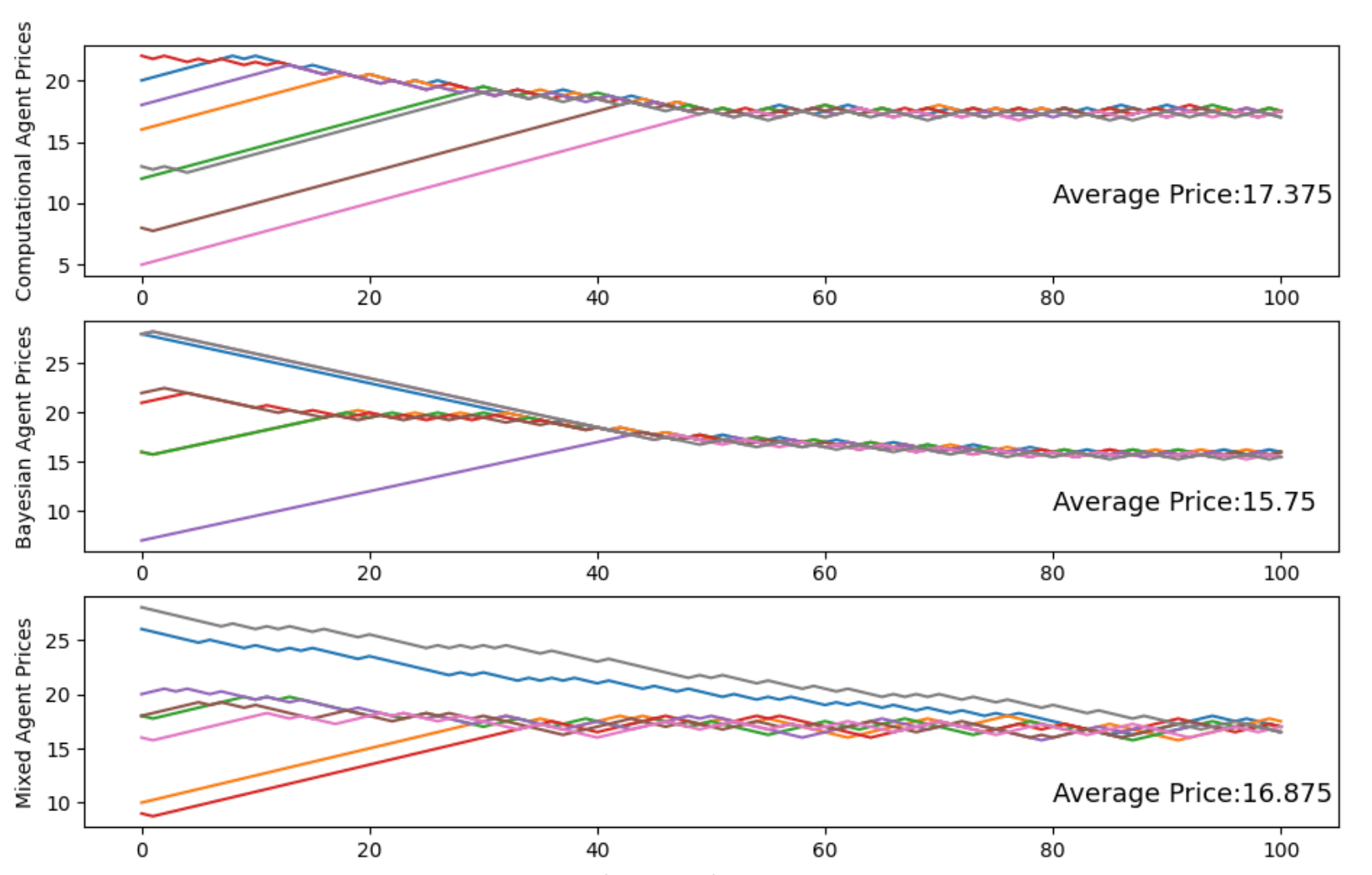
Agent-based modeling can study any social behavior and decision-making process, as agents make decisions based on an internal logic network and try to imitate human behavior. Proponents say that models based on agent interactions can inspire insight into policy and predict aggregate human behavior. Detractors concern themselves with the applicability of these results and whether such agents can fundamentally capture the nuance of human behavior. The solution lies in additional scale and complexity, often expensive to simulate and impossible with current computational methods for simulation. In this paper, we explore a new approach to agent-based modeling incorporating the properties of quantum mechanics and quantum computing. We build quantum adaptive long-term learning agents to measure the influence of external stimuli on a simple business structure comprised of those agents and evaluate the performance benefits from a quantum approach, comparing results with conventional Bayesian and Computational agents.
See also
- Weakening the Voting Rights Act reduces minority representation and electoral competitionPreprint, 2026
- Governance at a Crossroads: Artificial Intelligence and the Future of Innovation in AmericaSSRN, 2025
- Pheromone-based Learning of Optimal Reasoning PathsarXiv, 2025
- MINDSTORES: Memory-Informed Neural Decision Synthesis for Task-Oriented Reinforcement in Embodied SystemsICLR Workshop on Reasoning and Planning for LLMs; arXiv, 2025
- Insights into Flexible Bioinspired Fins for Unmanned Underwater Vehicle Systems through Deep LearningBiomimetics; NeurIPS Workshop on Machine Learning and the Physical Sciences, 2024