Pheromone-based Learning of Optimal Reasoning Paths
@misc{chari2025pheromonebasedlearningoptimalreasoning,
      title={Pheromone-based Learning of Optimal Reasoning Paths},
      author={Anirudh Chari and Aditya Tiwari and Richard Lian and Suraj Reddy and Brian Zhou},
      year={2025},
      eprint={2501.19278},
      archivePrefix={arXiv},
      primaryClass={cs.CL},
      url={https://arxiv.org/abs/2501.19278},
}
Abstract
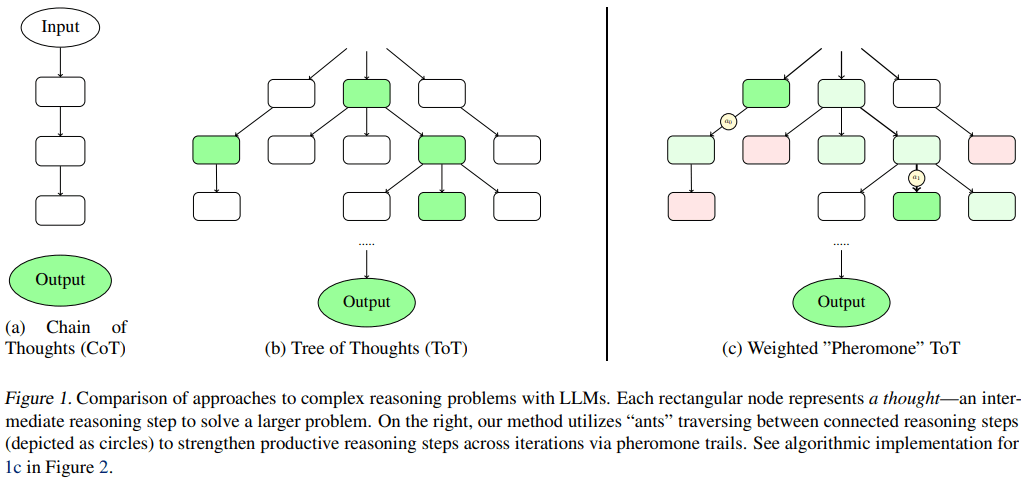
Large Language Models (LLMs) have demonstrated remarkable reasoning capabilities through chain-of-thought prompting, yet discovering effective reasoning methods for complex problems remains challenging due to the vast space of possible intermediate steps. We introduce Ant Colony Optimization-guided Tree of Thought (ACO-ToT), a novel algorithm that combines ACO with LLMs to discover optimal reasoning paths for complex problems efficiently. Drawing inspiration from Hebbian learning in neurological systems, our method employs a collection of distinctly fine-tuned LLM "ants" to traverse and lay pheromone trails through a centralized tree of thought, with each ant's movement governed by a weighted combination of existing pheromone trails and its own specialized expertise. The algorithm evaluates complete reasoning paths using a mixture-of-experts-based scoring function, with pheromones reinforcing productive reasoning paths across iterations. Experiments on three challenging reasoning tasks (GSM8K, ARC-Challenge, and MATH) demonstrate that ACO-ToT performs significantly better than existing chain-of-thought optimization approaches, suggesting that incorporating biologically inspired collective search mechanisms into LLM inference can substantially enhance reasoning capabilities.
See also
- MINDSTORES: Memory-Informed Neural Decision Synthesis for Task-Oriented Reinforcement in Embodied SystemsICLR Workshop on Reasoning and Planning for LLMs; arXiv, 2025
- Weakening the Voting Rights Act reduces minority representation and electoral competitionPreprint, 2026
- Governance at a Crossroads: Artificial Intelligence and the Future of Innovation in AmericaSSRN, 2025
- Insights into Flexible Bioinspired Fins for Unmanned Underwater Vehicle Systems through Deep LearningBiomimetics; NeurIPS Workshop on Machine Learning and the Physical Sciences, 2024
- A Framework to Apply Natural Language Processing Techniques to Analyze Public Opinions on Peace and Governance in AfricaAAPOR Conference, 2024