Weakening the Voting Rights Act reduces minority representation and electoral competition
@misc{kenny2026callais,
  author = {Kenny, Christopher T. and Zhou, Brian and Simko, Tyler and Imai, Kosuke},
  title  = {Weakening the Voting Rights Act Reduces Minority Representation and Electoral Competition},
  year   = {2026},
  month  = jun,
  note   = {Christopher T. Kenny and Brian Zhou contributed equally}
}
Abstract
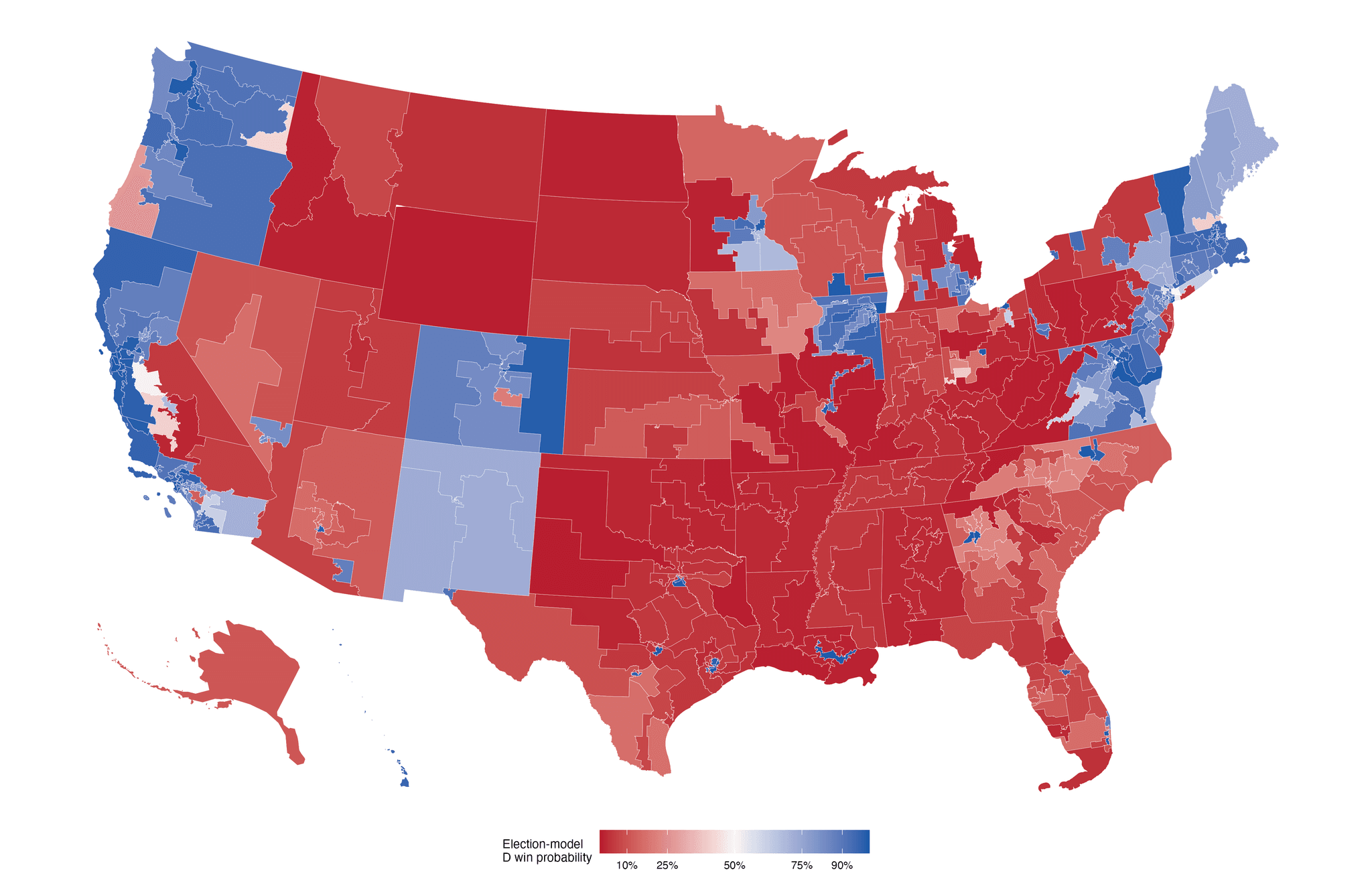
In April 2026, the US Supreme Court issued the Louisiana v. Callais decision, weakening the Voting Rights Act (VRA). We estimate the impact of the Callais decision on minority representation and electoral competition in the US House under two scenarios: (1) congressional district boundaries are drawn in a race-blind, nonpartisan manner without complying with the pre-Callais VRA requirements and (2) both parties engage in partisan gerrymandering to maximize their seat shares without considering former VRA protections. Our analysis uses simulation algorithms to generate alternative redistricting plans under these scenarios while satisfying traditional redistricting principles and state-specific criteria. First, we show that in aggregate the pre-Callais interpretation of the VRA created similar levels of minority representation to race-blind nonpartisan redistricting, suggesting that the VRA did not create large partisan advantages. Next, we show that if states continue to aggressively gerrymander, the Callais decision is likely to benefit the Republican Party and reduce minority representation in Congress. The greatest reductions in minority representation occur in Southern states with large and geographically concentrated Black populations. Finally, these gerrymandered plans further reduce the already low levels of electoral competition in congressional elections.
See also
- 50-State Redistricting Simulations for the 2020 Redistricting Cycle After Louisiana v. CallaisHarvard Dataverse, 2026
- alarmdata: Download, Merge, and Process Redistricting DataR package · CRAN, 2024
- Governance at a Crossroads: Artificial Intelligence and the Future of Innovation in AmericaSSRN, 2025
- Pheromone-based Learning of Optimal Reasoning PathsarXiv, 2025
- MINDSTORES: Memory-Informed Neural Decision Synthesis for Task-Oriented Reinforcement in Embodied SystemsICLR Workshop on Reasoning and Planning for LLMs; arXiv, 2025