Computational Approaches for Modeling Power Consumption on an Underwater Flapping Fin Propulsion System
@misc{zhou2023computationalapproachesmodelingpower,
      title={Computational Approaches for Modeling Power Consumption on an Underwater Flapping Fin Propulsion System},
      author={Brian Zhou and Jason Geder and Alisha Sharma and Julian Lee and Marius Pruessner and Ravi Ramamurti and Kamal Viswanath},
      year={2023},
      eprint={2310.14135},
      archivePrefix={arXiv},
      primaryClass={cs.RO},
      url={https://arxiv.org/abs/2310.14135},
}
Abstract
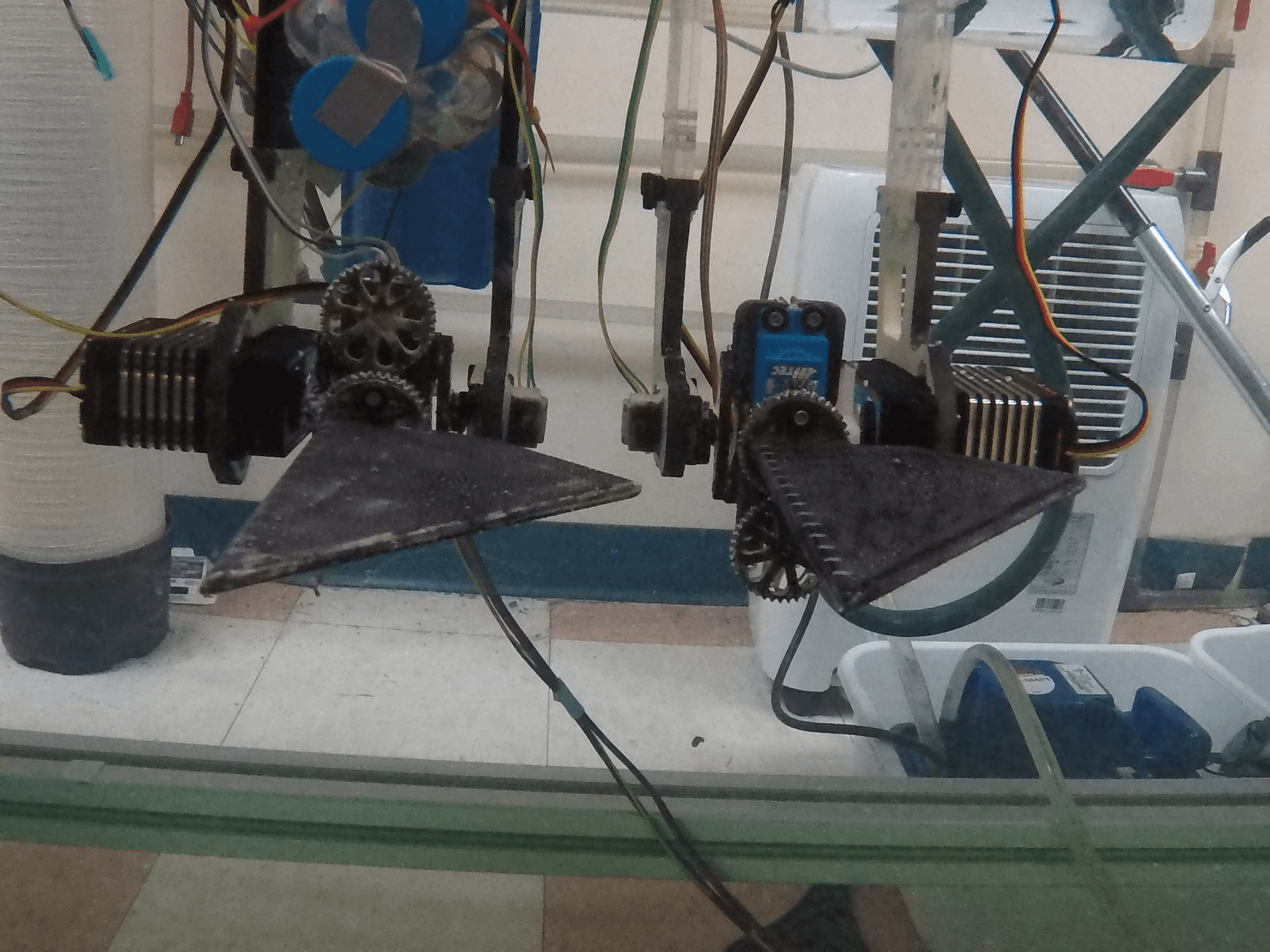
The last few decades have led to the rise of research focused on propulsion and control systems for bio-inspired unmanned underwater vehicles (UUVs), which provide more maneuverable alternatives to traditional UUVs in underwater missions. Propulsive efficiency is of utmost importance for flapping-fin UUVs in order to extend their range and endurance for essential operations. To optimize for different gait performance metrics, we develop a non-dimensional figure of merit (FOM), derived from measures of propulsive efficiency, that is able to evaluate different fin designs and kinematics, and allow for comparison with other bio-inspired platforms. We create and train computational models using experimental data, and use these models to predict thrust and power under different fin operating states, providing efficiency profiles. We then use the developed FOM to analyze optimal gaits and compare the performance between different fin materials. These comparisons provide a better understanding of how fin materials affect our thrust generation and propulsive efficiency, allowing us to inform control systems and weight for efficiency on an inverse gait-selector model.
See also
- Insights into Flexible Bioinspired Fins for Unmanned Underwater Vehicle Systems through Deep LearningBiomimetics; NeurIPS Workshop on Machine Learning and the Physical Sciences, 2024
- Power-Aware Inverse-Search Machine Learning for Low Resource Multi-Objective Unmanned Underwater Vehicle ControlAAAI Conference on Artificial Intelligence, 2024
- Data-Driven Machine Learning Models for a Multi-Objective Flapping Fin Unmanned Underwater Vehicle Control SystemAAAI Conference on Artificial Intelligence, 2023
- Weakening the Voting Rights Act reduces minority representation and electoral competitionPreprint, 2026
- Governance at a Crossroads: Artificial Intelligence and the Future of Innovation in AmericaSSRN, 2025