Papers coauthored with Kosuke Imai
Publications
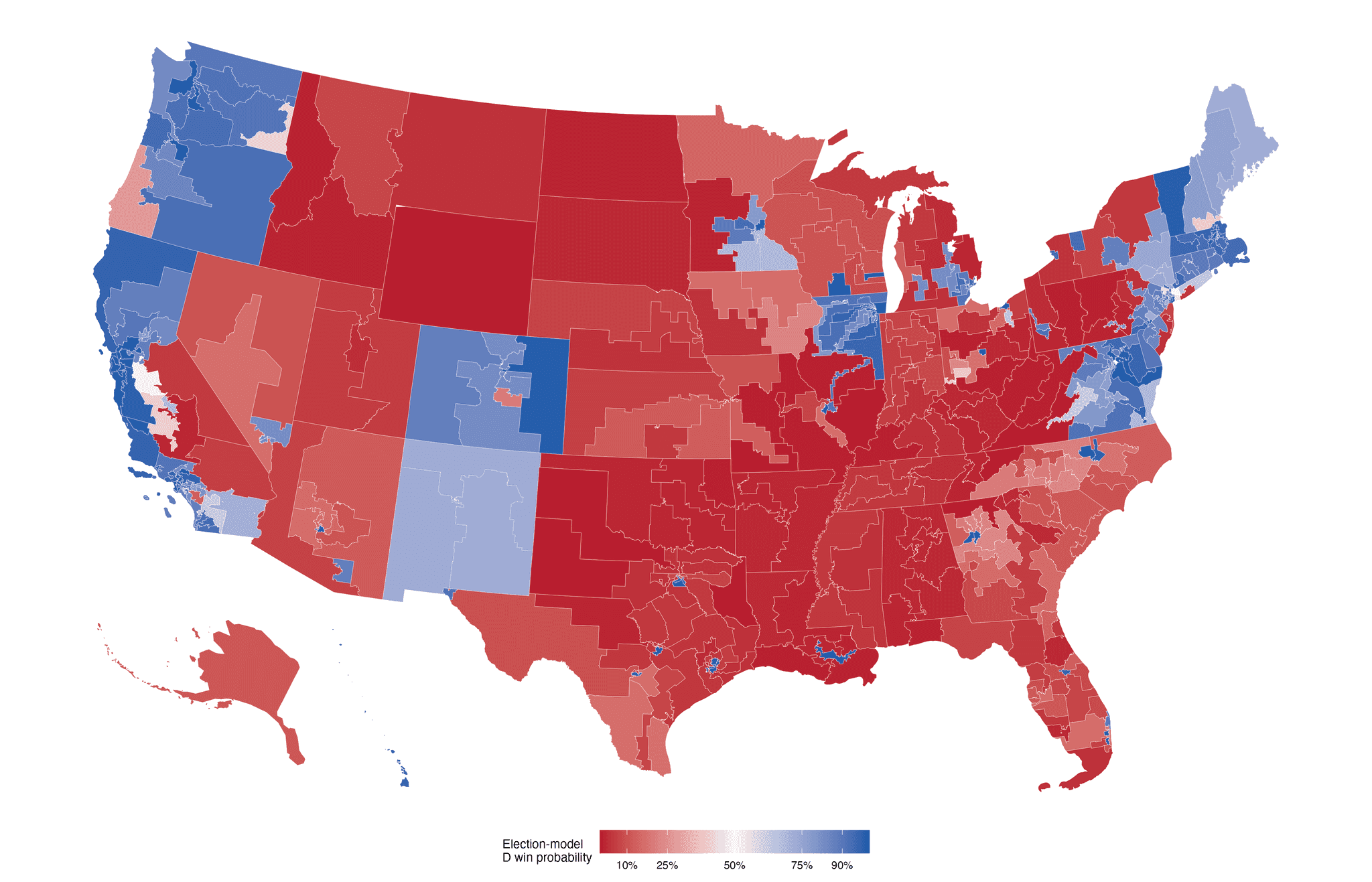
In April 2026, the US Supreme Court issued the Louisiana v. Callais decision, weakening the Voting Rights Act (VRA). We estimate the impact of the Callais decision on minority representation and electoral competition in the US House under two scenarios: (1) congressional district boundaries are drawn in a race-blind, nonpartisan manner without complying with the pre-Callais VRA requirements and (2) both parties engage in partisan gerrymandering to maximize their seat shares without considering former VRA protections. Our analysis uses simulation algorithms to generate alternative redistricting plans under these scenarios while satisfying traditional redistricting principles and state-specific criteria. First, we show that in aggregate the pre-Callais interpretation of the VRA created similar levels of minority representation to race-blind nonpartisan redistricting, suggesting that the VRA did not create large partisan advantages. Next, we show that if states continue to aggressively gerrymander, the Callais decision is likely to benefit the Republican Party and reduce minority representation in Congress. The greatest reductions in minority representation occur in Southern states with large and geographically concentrated Black populations. Finally, these gerrymandered plans further reduce the already low levels of electoral competition in congressional elections.
@misc{kenny2026callais,
  author = {Kenny, Christopher T. and Zhou, Brian and Simko, Tyler and Imai, Kosuke},
  title  = {Weakening the Voting Rights Act Reduces Minority Representation and Electoral Competition},
  year   = {2026},
  month  = jun,
  note   = {Christopher T. Kenny and Brian Zhou contributed equally}
}- Why Neutral Maps Could Empower Black Voters as Much as the Voting Rights Actin The New York Times (The Upshot)
Software

alarmdata: Download, Merge, and Process Redistricting Data
Utility functions to download and process data produced by the ALARM Project, including 2020 redistricting files Kenny and McCartan (2021) https://alarm-redist.org/posts/2021-08-10-census-2020/ and the 50-State Redistricting Simulations of McCartan, Kenny, Simko, Garcia, Wang, Wu, Kuriwaki, and Imai (2022). The package extends the data introduced in McCartan, Kenny, Simko, Garcia, Wang, Wu, Kuriwaki, and Imai (2022) to also include states with only a single district.
@Manual{mccartan2024alarmdata,
  title  = {alarmdata: Download, Merge, and Process Redistricting Data},
  author = {McCartan, Cory and Kenny, Christopher T. and Simko, Tyler and Zhao, Michael and Miyazaki, Sho and Zhou, Brian and Imai, Kosuke},
  year   = {2024},
  note   = {R package},
  doi    = {10.32614/CRAN.package.alarmdata},
  url    = {https://cran.r-project.org/package=alarmdata}
}
Datasets

50-State Redistricting Simulations for the 2020 Redistricting Cycle After Louisiana v. Callais
Every decade following the Census, states and municipalities must redraw districts for Congress, state houses, city councils, and more. The goal of the 50-State Simulation Project is to enable researchers, practitioners, and the general public to use cutting-edge redistricting simulation analysis to evaluate enacted congressional districts. Evaluating a redistricting plan requires analysts to take into account each state's redistricting rules and particular political geography. Comparing the partisan bias of a plan for Texas with the bias of a plan for New York, for example, is likely misleading. Comparing a state's current plan to a past plan is also problematic because of demographic and political changes over time. Redistricting simulations generate an ensemble of alternative redistricting plans within a given state which are tailored to its redistricting rules. Unlike traditional evaluation methods, therefore, simulations are able to directly account for the state's political geography and redistricting criteria. This dataset contains sampled districting plans and accompanying summary statistics for all 50 U.S. states.
@misc{kenny2026fiftystate,
  author    = {Kenny, Christopher T. and Zhou, Brian and Simko, Tyler and Imai, Kosuke},
  title     = {50-State Redistricting Simulations for the 2020 Redistricting Cycle After Louisiana v. Callais},
  year      = {2026},
  publisher = {Harvard Dataverse},
  doi       = {10.7910/DVN/A3SE7Y},
  url       = {https://doi.org/10.7910/DVN/A3SE7Y}
}