Papers coauthored with Kamal Viswanath
Publications
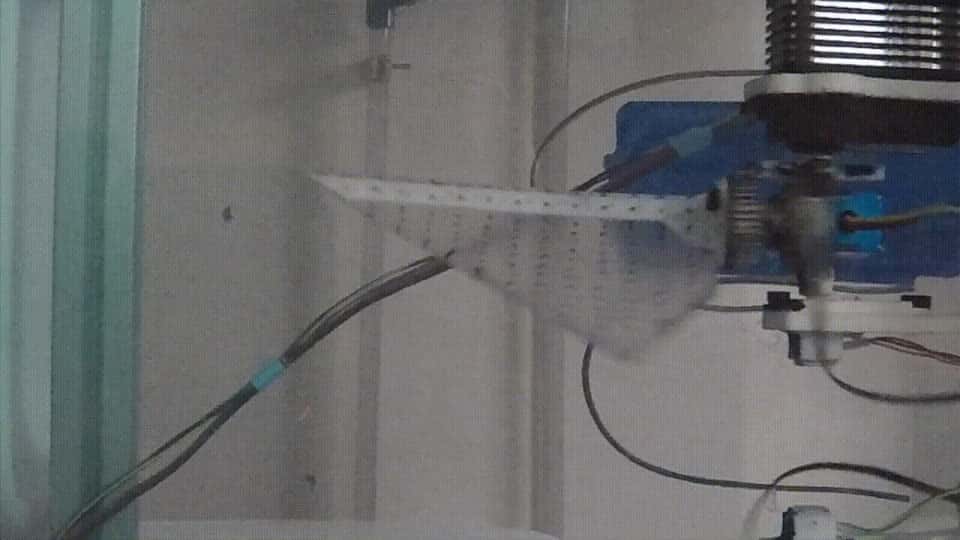
Insights into Flexible Bioinspired Fins for Unmanned Underwater Vehicle Systems through Deep Learning
The last few decades have led to the rise of research focused on propulsion and control systems for bio-inspired unmanned underwater vehicles (UUVs), which provide more maneuverable alternatives to traditional UUVs in underwater missions. Recent work has explored the use of time-series neural network surrogate models to predict thrust and power from vehicle design and fin kinematics. We expand upon this work, creating new forward neural network models that encapsulate the effects of the material stiffness of the fin on its kinematic performance, thrust, and power, and are able to interpolate to the full spectrum of kinematic gaits for each material. Notably, we demonstrate through testing of holdout data that our developed forward models capture the thrust and power associated with each set of parameters with high resolution, enabling highly accurate predictions of previously unseen gaits and thrust and FOM gains through proper materials and kinematics selection. As propulsive efficiency is of utmost importance for flapping-fin UUVs in order to extend their range and endurance for essential operations, a non-dimensional figure of merit (FOM), derived from measures of propulsive efficiency, is used to evaluate different fin designs and kinematics and allow for comparison with other bio-inspired platforms. We use the developed FOM to analyze optimal gaits and compare the performance between different fin materials. The forward model demonstrates the ability to capture the highest thrust and FOM with good precision, which enables us to improve thrust generation by 83.89% and efficiency by 137.58% with proper fin stiffness and kinematics selection, allowing us to improve material selection for bio-inspired fin design.
@Article{biomimetics9070434,
AUTHOR = {Zhou, Brian and Viswanath, Kamal and Geder, Jason and Sharma, Alisha and Lee, Julian},
TITLE = {Insights into Flexible Bioinspired Fins for Unmanned Underwater Vehicle Systems through Deep Learning},
JOURNAL = {Biomimetics},
VOLUME = {9},
YEAR = {2024},
NUMBER = {7},
ARTICLE-NUMBER = {434},
URL = {https://www.mdpi.com/2313-7673/9/7/434},
PubMedID = {39056875},
ISSN = {2313-7673},
ABSTRACT = {The last few decades have led to the rise of research focused on propulsion and control systems for bio-inspired unmanned underwater vehicles (UUVs), which provide more maneuverable alternatives to traditional UUVs in underwater missions. Recent work has explored the use of time-series neural network surrogate models to predict thrust and power from vehicle design and fin kinematics. We expand upon this work, creating new forward neural network models that encapsulate the effects of the material stiffness of the fin on its kinematic performance, thrust, and power, and are able to interpolate to the full spectrum of kinematic gaits for each material. Notably, we demonstrate through testing of holdout data that our developed forward models capture the thrust and power associated with each set of parameters with high resolution, enabling highly accurate predictions of previously unseen gaits and thrust and FOM gains through proper materials and kinematics selection. As propulsive efficiency is of utmost importance for flapping-fin UUVs in order to extend their range and endurance for essential operations, a non-dimensional figure of merit (FOM), derived from measures of propulsive efficiency, is used to evaluate different fin designs and kinematics and allow for comparison with other bio-inspired platforms. We use the developed FOM to analyze optimal gaits and compare the performance between different fin materials. The forward model demonstrates the ability to capture the highest thrust and FOM with good precision, which enables us to improve thrust generation by 83.89% and efficiency by 137.58% with proper fin stiffness and kinematics selection, allowing us to improve material selection for bio-inspired fin design.},
DOI = {10.3390/biomimetics9070434}
}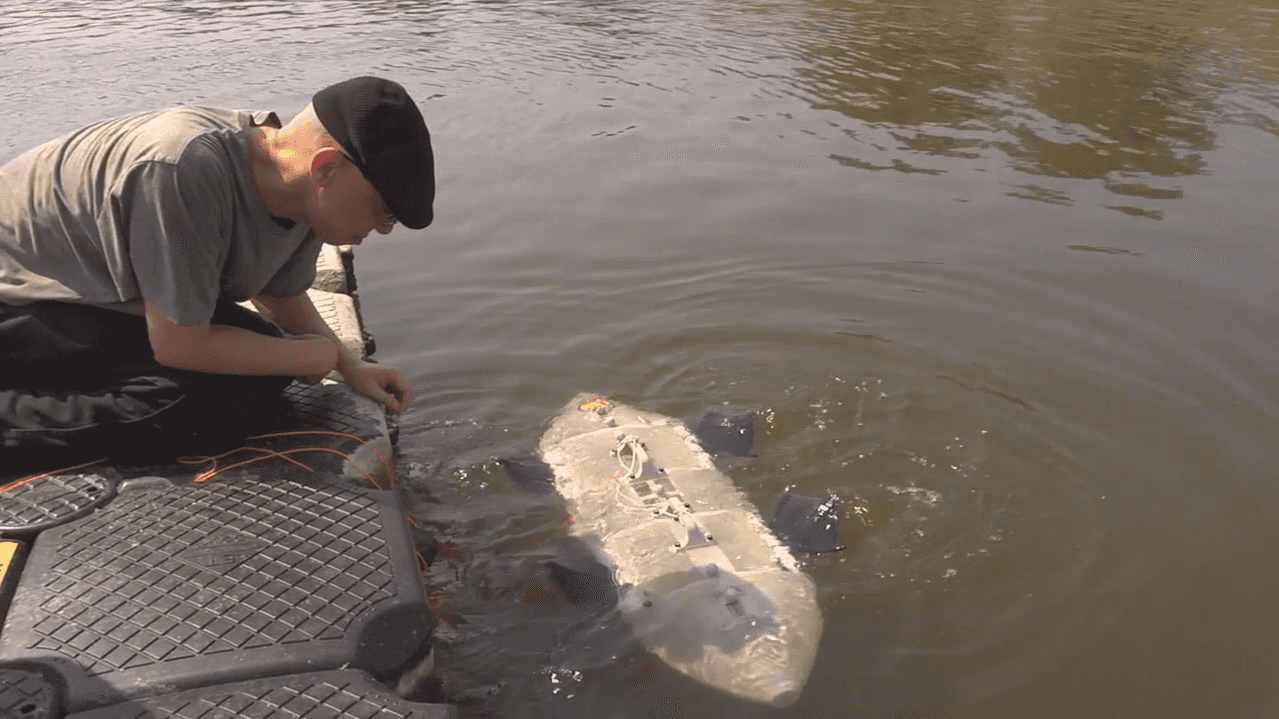
Power-Aware Inverse-Search Machine Learning for Low Resource Multi-Objective Unmanned Underwater Vehicle Control
Flapping-fin unmanned underwater vehicle (UUV) propulsion systems enable high maneuverability for tasks ranging from station-keeping to surveillance but are often constrained by their limited computational power and battery capacity. Previous research has demonstrated that time-series neural network models can accurately predict the thrust and power of certain fin kinematics based on the specified gait coupled with the fin configuration, but can not fit an inverse neural network that takes a thrust request and tunes the kinematics by weighting thrust generation, smooth movement transitions, and power attributes. We study various combinations of the three weights and fin materials to create different 'modes' of movement for a multi-objective UUV, based on controller intent using an inverse neural network. Finally, we implement and validate an enhanced power-aware inverse model by benchmarking on the Raspberry Pi Model 4B system and testing through generated simulated movements.
@article{Zhou_Geder_Viswanath_Sharma_Lee_2024, title={Power-Aware Inverse-Search Machine Learning for Low Resource Multi-Objective Unmanned Underwater Vehicle Control (Student Abstract)}, volume={38}, url={https://ojs.aaai.org/index.php/AAAI/article/view/30538}, DOI={10.1609/aaai.v38i21.30538}, abstractNote={Flapping-fin unmanned underwater vehicle (UUV) propulsion systems enable high maneuverability for tasks ranging from station-keeping to surveillance but are often constrained by their limited computational power and battery capacity. Previous research has demonstrated that time-series neural network models can accurately predict the thrust and power of certain fin kinematics based on the specified gait coupled with the fin configuration, but can not fit an inverse neural network that takes a thrust request and tunes the kinematics by weighting thrust generation, smooth movement transitions, and power attributes. We study various combinations of the three weights and fin materials to create different 'modes' of movement for a multi-objective UUV, based on controller intent using an inverse neural network. Finally, we implement and validate an enhanced power-aware inverse model by benchmarking on the Raspberry Pi Model 4B system and testing through generated simulated movements.}, number={21}, journal={Proceedings of the AAAI Conference on Artificial Intelligence}, author={Zhou, Brian and Geder, Jason and Viswanath, Kamal and Sharma, Alisha and Lee, Julian}, year={2024}, month={Mar.}, pages={23714-23716} }- AAAI 2024 Outstanding Student AbstractRecognized for exceptional contribution to AI research in power-aware machine learning for underwater robotics.
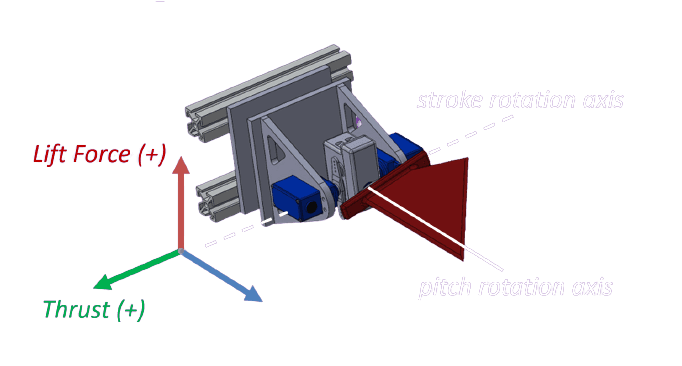
Data-Driven Machine Learning Models for a Multi-Objective Flapping Fin Unmanned Underwater Vehicle Control System
Flapping-fin unmanned underwater vehicle (UUV) propulsion systems provide high maneuverability for naval tasks such as surveillance and terrain exploration. Recent work has explored the use of time-series neural network surrogate models to predict thrust from vehicle design and fin kinematics. We develop a search-based inverse model that leverages a kinematics-to-thrust neural network model for control system design. Our inverse model finds a set of fin kinematics with the multi-objective goal of reaching a target thrust and creating a smooth kinematic transition between flapping cycles. We demonstrate how a control system integrating this inverse model can make online, cycle-to-cycle adjustments to prioritize different system objectives.
@article{Lee_Viswanath_Sharma_Geder_Pruessner_Zhou_2024, title={Data-Driven Machine Learning Models for a Multi-Objective Flapping Fin Unmanned Underwater Vehicle Control System}, volume={37}, url={https://ojs.aaai.org/index.php/AAAI/article/view/26863}, DOI={10.1609/aaai.v37i13.26863}, abstractNote={Flapping-fin unmanned underwater vehicle (UUV) propulsion systems provide high maneuverability for naval tasks such as surveillance and terrain exploration. Recent work has explored the use of time-series neural network surrogate models to predict thrust from vehicle design and fin kinematics. We develop a search-based inverse model that leverages a kinematics-to-thrust neural network model for control system design. Our inverse model finds a set of fin kinematics with the multi-objective goal of reaching a target thrust and creating a smooth kinematic transition between flapping cycles. We demonstrate how a control system integrating this inverse model can make online, cycle-to-cycle adjustments to prioritize different system objectives.}, number={13}, journal={Proceedings of the AAAI Conference on Artificial Intelligence}, author={Lee, Julian and Viswanath, Kamal and Sharma, Alisha and Geder, Jason and Pruessner, Marius and Zhou, Brian}, year={2024}, month={Jul.}, pages={15703-15709} }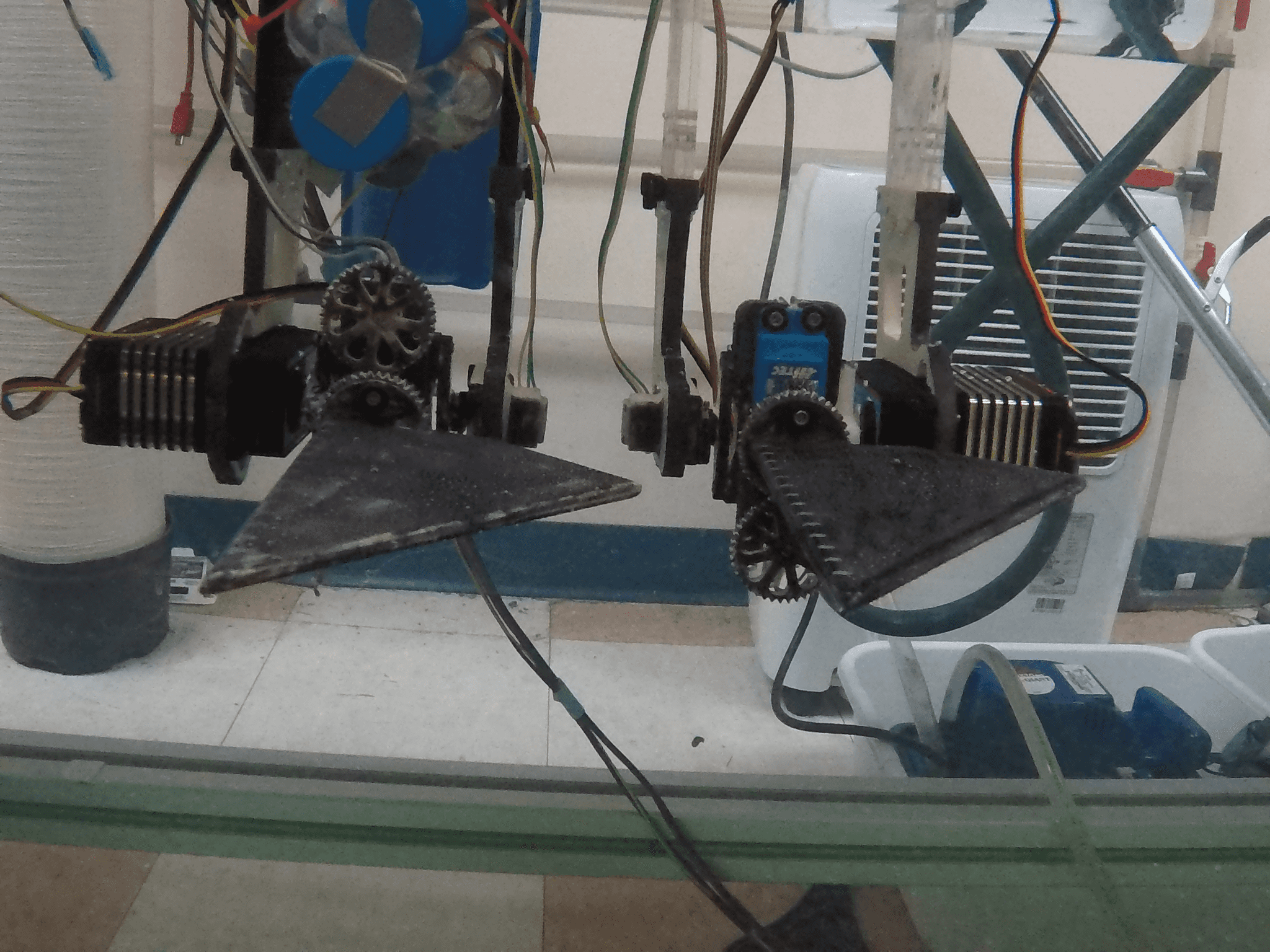
Computational Approaches for Modeling Power Consumption on an Underwater Flapping Fin Propulsion System
The last few decades have led to the rise of research focused on propulsion and control systems for bio-inspired unmanned underwater vehicles (UUVs), which provide more maneuverable alternatives to traditional UUVs in underwater missions. Propulsive efficiency is of utmost importance for flapping-fin UUVs in order to extend their range and endurance for essential operations. To optimize for different gait performance metrics, we develop a non-dimensional figure of merit (FOM), derived from measures of propulsive efficiency, that is able to evaluate different fin designs and kinematics, and allow for comparison with other bio-inspired platforms. We create and train computational models using experimental data, and use these models to predict thrust and power under different fin operating states, providing efficiency profiles. We then use the developed FOM to analyze optimal gaits and compare the performance between different fin materials. These comparisons provide a better understanding of how fin materials affect our thrust generation and propulsive efficiency, allowing us to inform control systems and weight for efficiency on an inverse gait-selector model.
@misc{zhou2023computationalapproachesmodelingpower,
      title={Computational Approaches for Modeling Power Consumption on an Underwater Flapping Fin Propulsion System},
      author={Brian Zhou and Jason Geder and Alisha Sharma and Julian Lee and Marius Pruessner and Ravi Ramamurti and Kamal Viswanath},
      year={2023},
      eprint={2310.14135},
      archivePrefix={arXiv},
      primaryClass={cs.RO},
      url={https://arxiv.org/abs/2310.14135},
}