MSS 1: AIs are mismanaged, robots are learning in context, and countries are securing supply chains
Here’s everything I read from August 24th to August 30th.

Welcome to my new blog! Each week, I’ll be trying to summarize new research and current events that I think are important to know about, along with analysis and my thoughts appended on. Our world is rapidly changing from accelerated progress in AI and robotics, with implications that carry to our economy, society, and countries. I’ll be documenting what I see here.
This week, I’m talking about why LLM-generated populations are too normal, what happens when an AI improves its own harness for chip design, how robots are learning new tasks from single demonstrations, and why Britain is buying its way back into the tungsten market.
Get Machines, Systems, and States in your inbox.
AI
In AI for social science, researchers showed that LLMs still struggle to reproduce the messiness of real human populations. On the engineering side, Christina Lee makes the case that apparent model limitations are management failures; AI can improve not only a chip design, but also the harness it uses to design the chip.
LLMs are bad at approximating human populations with sparse data
Source: Xie et al. in PNAS: Evaluating the statistical realism of LLM-generated social science data and Mengdi Wang’s paper announcement tweet
Large language models are increasingly being used to generate synthetic survey respondents, digital twins, and entire agent populations. There are a whole host of startups that have been founded with the purpose of synthetic surveys for political polling, product behavior testing, and clinical trial evaluation, including unicorns such as Aaru and Simile.
But a team of researchers from Princeton University and Peking University finds that these simulated humans are much tidier than real ones: even if an individual looks believable, the resulting populations cluster too tightly. They follow conventional life paths and exhibit much stronger stereotypes than people in real surveys do.
What they did: The researchers built SocialScienceDataBench (SSDataBench) to test the population-level statistical realism of LLM-generated data. They sampled 1,000 people from each of seven established datasets covering the United States, China, and the United Kingdom. The datasets span demographics, socioeconomic status, marriage, health, abilities, and attitudes.
Fifteen LLMs were given a respondent’s demographic background, along with the relevant location and timeframe. They were asked to generate the survey answers or describe the respondent’s life history. The researchers then compared the resulting synthetic populations with the observed survey data across five dimensions:
- Univariate distributions; whether individual variables have the right spread, rather than merely the right average.
- Bivariate associations; whether pairs of characteristics relate to one another with the right strength.
- Multivariate predictions; whether demographic characteristics collectively predict outcomes to a realistic degree.
- Life-event sequences; whether events such as starting work, marrying, and having children occur in the same variety of orders.
- Life-event relationships; whether those trajectories relate realistically to people’s other characteristics.
For each comparison, the researchers repeatedly sampled 500 real and 500 synthetic records and tested whether their statistics differed significantly. They used this to calculate a “pass rate” that measured how often the test could not distinguish the synthetic statistic from the real one: higher is thus better. GPT-4 and Llama 3.1 led the benchmark, but their average pass rate across datasets and statistical patterns was only 0.30. Most models scored between roughly 0.19 and 0.30. Within model families (such as GPT-5 vs GPT-4), newer models did not consistently outperform their predecessors by improving the realism of the overall population.
The authors argue this is a structural challenge: LLMs are trained to produce a good answer one case at a time, not to ensure that thousands of answers collectively reproduce a population distribution.
Models are mode seekers: As Mengdi Wang puts it, LLMs behave like highly effective “mode seekers.” They find a high-probability social type and repeatedly generate variations of it.
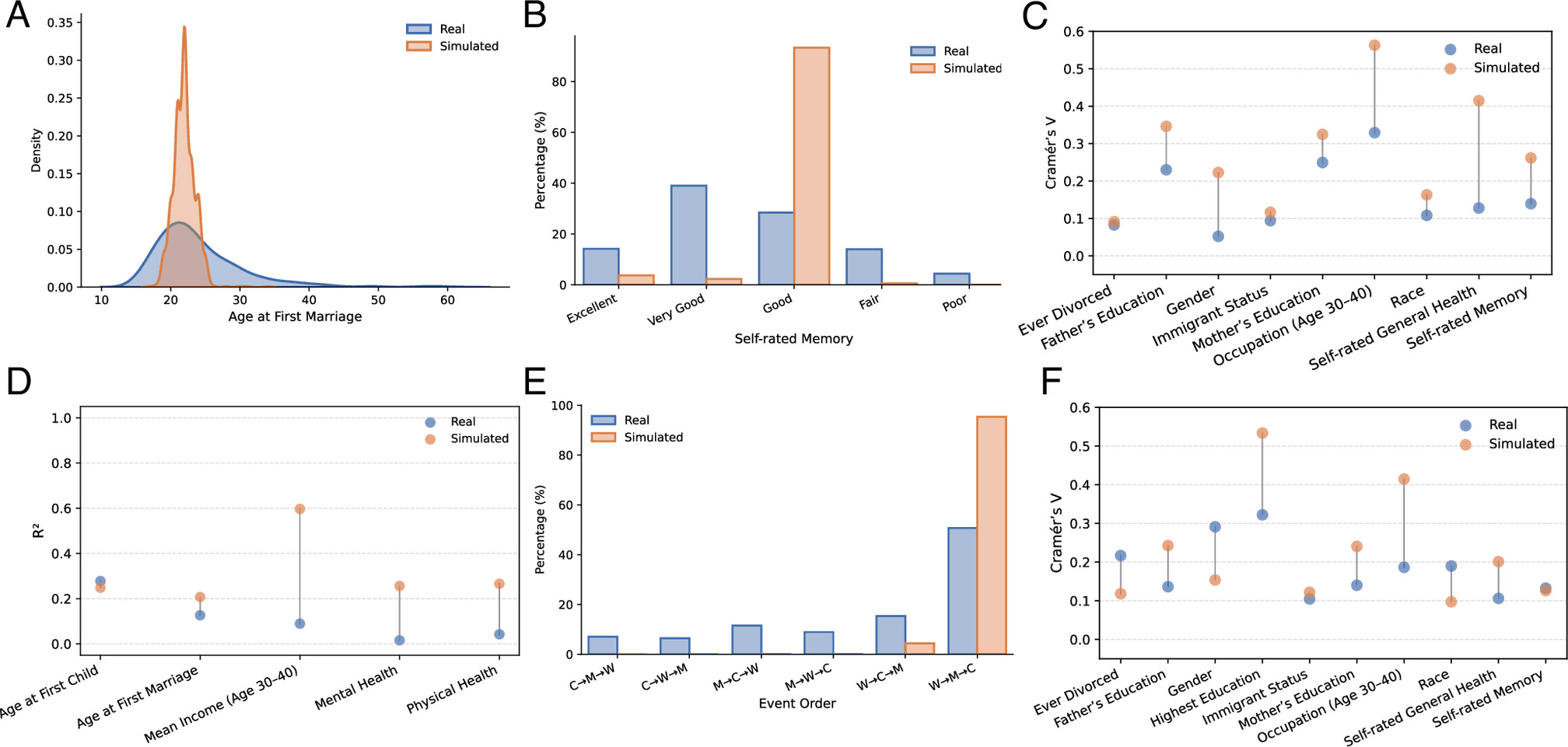
The synthetic populations are not sufficiently ‘strange’ enough. LLMs don’t do well at creating this long-tail of all of the possible combinations of beliefs that people have, and instead cluster around many traditional/stereotypical life histories. In particular, models almost completely failed to replicate life-event sequence distributions (3E) that asked a model to say when starting work, first marriage, and first child occurred for a given person’s life. The long-tail for this is practically non-existent, even though the model is correct that work -> marriage -> childbirth in a linear order is the most common scenario, it overestimates this by a factor of two and ends up completely missing any other permutation except for work -> childbirth -> marriage.
We’ve known this is a problem with models for a while. Consider the Obama birthplace problem: Luke Wines of VoteHub explains how it is extremely difficult to make an LLM-simulated voter say Barack Obama was born outside the United States. But in an April 2011 Gallup poll, 24% of Americans said Obama was probably or definitely born in another country.
Wines’s observation is anecdotal, but it captures the underlying problem nicely. An LLM that knows the truth of this can completely miss this when simulating the population. To reproduce real public opinion, an LLM must sometimes generate answers that are false, contradictory, or unintuitive. It also needs to get the overall distribution right.
Targeted training helps: When the researchers fine-tuned Llama 3.1 8B on 1,000 records from the 1970 CPS-ASEC survey, its average pass rate rose:
- From 0.258 to 0.534 on CPS-ASEC 1980.
- From 0.270 to 0.442 on the 1980 Census.
- From 0.325 to 0.402 on the 2018 General Social Survey.
These are preliminary results, but they suggest the problem is not impossible to fix. It may just be that natural language is a poor way to represent population statistics, and directly training on survey microdata appears to give models this understanding that they otherwise lack.
Why this matters – out of the box LLMs aren’t representative: A synthetic respondent who sounds human is not necessarily a valid substitute for a surveyed human. Out-of-the-box LLMs are not yet suitable for the work that social scientists care about. Ungrounded LLM populations are particularly risky for public opinion research, policy simulations, population analysis, and attempts to predict elections or social behavior.
However, SSDataBench is limiting the scope of the study to general-purpose LLMs under sparse survey-style conditioning, where you may only get multiple-choice style answers about a very small number of disparate topics. Richer interviews, behavioral data, and domain-specific training would likely produce better individual simulations, which is the type of work that startups such as Aaru and Simile are trying to do.
Speculation zone: If we are only thinking about the capabilities of a model to accurately represent a population, is it possible we’re thinking about this in the wrong way? When we think about using AI to sample an entire population, we’re thinking about this top-down data approach of using an LLM to create a representative population of individuals. But what about a bottom-up approach?
Traditional recommendation systems have existed for decades, and they have already shown this in practice with how they construct a representative population. The data process of making a recommendation system is very bottom-up. It starts by aggregating millions of individual user behaviors and signals (clickthrough rate, whether they actually bought something, how long they spent looking at a certain movie trailer) to find patterns and draw conclusions about what types of ads or movies they should serve to any given user.
There is a growing body of literature that supports the concept of ‘AI delegates’ that would be able to act on your behalf, or use values that it knows you have to recommend policy platforms you should check out or things you should think about doing. This has been augmented by continued improvements in the ways that AI companies ‘remember’ core information from a past user. While it was first introduced by OpenAI in April 2024 and Anthropic in September 2025, both have continued work on improving memory systems through asynchronously ‘dreaming’ in June and April 2026 respectively. Instead of just writing a memory, it goes a step further: it asynchronously sifts through memories and makes sure they are relevant and up to date. I’m speculating that continued progress in memory across conversations, including specific memories of your overall preferences will make future AI systems much more competent at being your AI delegate. The authors themselves mention that one of the best ways to improve the overall pass rate is simply by passing in more information; it’s pretty plausible that the best way to simulate human society is simply by having all of the information you possibly can.
Of course, this breaks down when we get into the intent of using LLMs in this branch of the social sciences, which is polling undertaken by people who aren’t the major AI labs. This bottom-up approach is only something that the AI labs themselves can do, since it’s pretty unlikely that you would be able to release this data publicly without risks of deanonymization. Still, this could be extremely interesting for new surveys and simulations that might give us better insights into open social science questions!
The geniuses are still mismanaged: Having an AI improve how it designs chips
Source: Christina Lee’s blogpost You can design a chip to run Kimi K3 at 87000 tps??? and announcement tweet
Inspired by the Kimi K3 technical report, Christina Lee built a ‘Meta Harness’ for AI chip design– this is where an LLM creates the hardware designs as well as refines the process that it uses to create these designs.
How it works: The system operates as a closed loop where it modifies SystemVerilog (the hardware verification language for chips; verilog:chips as lean:math), tests it through an existing open source chip design flow, and changes the scaffold when the model hits a wall in making progress.
The model effectively plays two roles:
- The hardware designer writes and modifies SystemVerilog for components of a Kimi Delta Attention accelerator.
- The harness designer changes how later hardware designers approach the task—what reports they inspect, which bottleneck they blame, what class of architectural repair they attempt, and how they select the next optimization target.
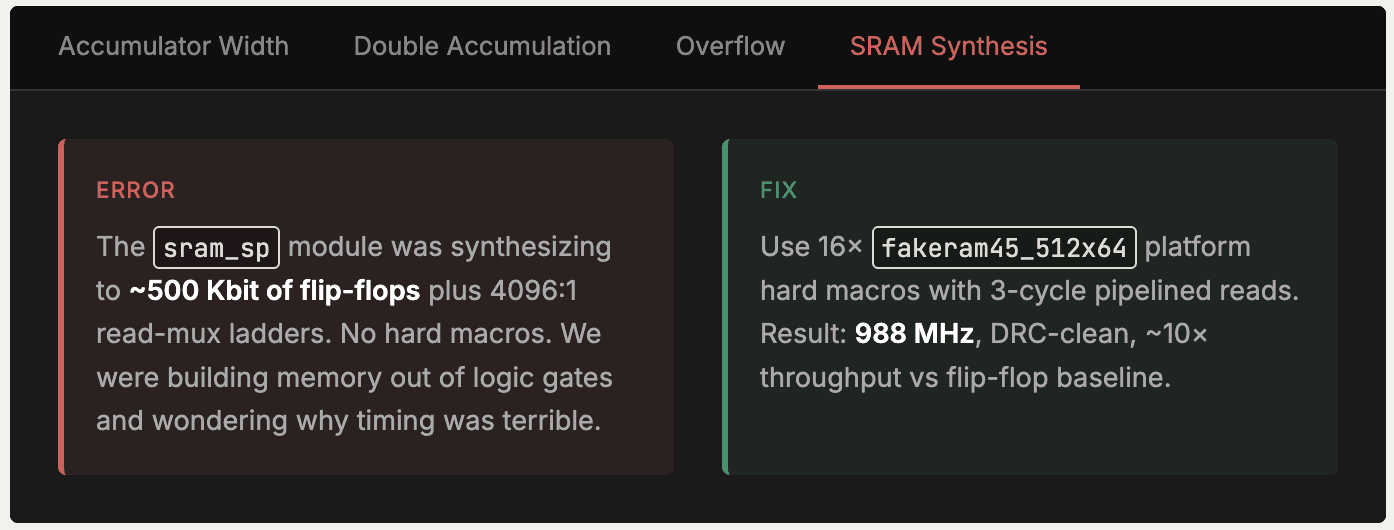
Rather than improving the weights of the model itself through traditional RL, the project unlocks additional latent capability in the model through accumulating capability in the prompts, diagnostic routines, policies, tests, and report-selection rules used to manage later model calls. In other words, it tries to improve both the chip and the process by which the AI improves the chip.
Christina sets two variables, X, which identifies a generation of the harness, and Y, which identifies a hardware design made within a specific harness generation.
Each design is created and evaluated on metrics like clock frequency, area, and design violations. These attempts are recorded in a trials.jsonl file that contains the original goal, the end result, metrics and bugs discovered, and lessons learned. If one iteration of failed, it just means that that particular design didn’t work. But if a row of all the way to fails or hits a performance ceiling, then the system sees that the harness is thinking about the problem incorrectly and looks through the lessons learned in the failed row to design a new generation .
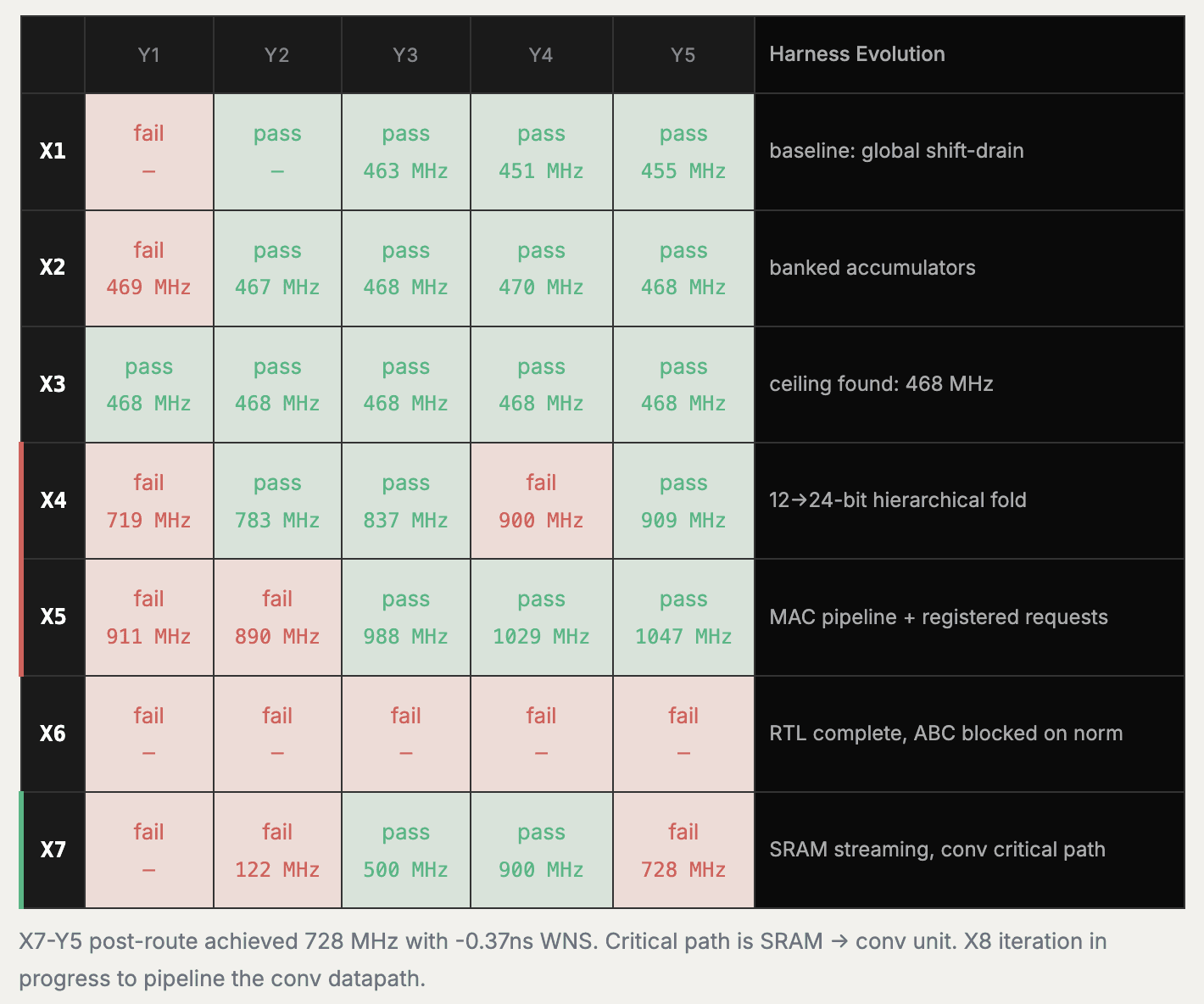
Why this matters – recursive improvement in the manager: Most agent systems keep the surrounding workflow fixed. For example, the latest Erdos problem was solved by the supervisor simply going and telling the model to keep going and continuing with its work. Self-improving harnesses can likely automate out a lot of this work, and help us in escaping failure modes quicker. Christina’s system shows that repeated failure can often be problems with the harness, and traces from previous iterations can allow successful strategies to be preserved and later attempts to approach a failed problem differently.
This project is a fairly literal implementation of MIT PhD student Alex Zhang’s Mismanaged Geniuses Hypothesis: perceived model limitations could just come from how individual calls are organized, instead of the underlying model actually just not having the knowledge necessary to do a given task.
It is also a crude form of what meta-level recursive self-improvement could look like (for chip design, at least). Each iteration can produce both a better circuit and better reflection for producing the next circuit. Chip design is particularly attractive for this because the parts Christina tests are incredibly verifiable through simulators and physical-design tools.
Limitations: Keep in mind that this was purely an academic design. The 87,000 TPS figure (as acknowledged in the blogpost) is a theoretical extrapolation and would need to be fully taped out, alongside other considerations that were kept out of the scope of this project.
Robotics
It was a crazy week for robotics. On the hardware side, we had the 2026 Humanoid Robot Games held in China. On the intelligence side, we’ve seen a major breakthrough in in-context learning and continued progress in scaling training data.
China’s 2026 Humanoid Games: hardware keeps getting better
Here’s the recap: China’s second World Humanoid Robot Games just took place. It featured 2,056 different humanoid embodiments from 666 teams (a very lucky number in China) from 16 countries competing across 51 different sports and tasks. The vast majority of these were Chinese teams and humanoids: of the 666 teams, 641 were domestic, bringing 1,975 of the 2,056 robots. Those entries came from 157 companies and 200 universities and research institutes.
Humanoid robots surpassed a wide range of human records. Across many humanoids that broke human records, the Tiangong Ultra broke Usain Bolt's 9.58 second 100 meter world record (8.64s) and Wayde van Niekerk’s 43.03 second 400 meter world record (38.15s). Two robots also broke the human world record for the high jump, held by Javier Sotomayor at 2.45m.
More meaningful is how these robots performed compared to humanoids in last year’s competition: the best 100-meter time fell from 21.50 seconds to 8.64, while the 400-meter time fell from 1:28.03 to 38.15. It’s a very clear demonstration that humanoids are rapidly improving at faster locomotion and whole-body control, even when we impose arbitrary constraints on the embodiments themselves. Remember – if we wanted an embodiment that was just good at running, we could just make an autonomous vehicle instead! This led to some viral videos of companies implementing funny-looking running styles to work around overloading the motors while optimizing for speed.

Better robots are coming, and they’re coming fast. What’s most impressive to me is Galbot’s specific demonstration of its robot that played tennis. It successfully played over a hundred autonomous rallies (no teleoperation/remote control) against human players. Unlike just running down a fast track (for which non-humanoid embodiments are already more optimal), playing tennis demonstrates that robots are improving in much more relevant axes for deployment into the real world. Playing tennis requires the robot to repeatedly perceive where a fast-moving ball is, coordinate its body to move into position in the needed time, and then execute a fast-paced stroke to return the ball.
Sure, there are limitations to this. This tennis playing humanoid, for example, relies on an extensive set of more than 50 motion capture camera systems that are set up to give the robot a field of view of the entire court. You can see two of these cameras to the left and right of the humanoid, but they’re instrumented all around the court.
But we don’t care about whether the compute or camera systems are onboard in most productive settings. Factory settings similarly are not constrained by either compute or your ability to rig up camera systems. If all that is needed to get hardware that can perform work fast is just more cameras in the environment, this is very easily doable.
All that matters is speed and cost, and it’s clear Galbot has made significant strides in a task that requires fast action-reaction cycles. This is vastly different compared to the slow demos we’ve seen with Figure’s deployments in factories, for example, where the problem is that the humanoids themselves are very slow, and can’t match a human’s sorting speed.
In-context learning for physical intelligence is here
Sources: Skild’s Introducing S1: In-Context Learning for Robotics and Generalist’s GEN-1.5: Embodied Foundation Models are One-Shot Learners
Robots just got their GPT-3 equivalent* of learning within prompts. Within a day of each other, Generalist and Skild announced models that can attempt a new physical task after being shown one example, without collecting a new task-specific dataset or changing the model’s weights.
Here is how the companies describe the shift:
“Show it a video of a task, short or long, seen or unseen, and it executes.” - Skild
“The model learns new tasks in seconds when prompted with 3 to 12 seconds of a single demonstration.” - Generalist
What in-context learning means for a robot: Today, deploying a robot on a new task often means sending a deployment team to collect demonstrations, fine-tune a specialist policy from a general pretrained model, test it, discover failures, and collect more data to make deployments economically viable. This could take anywhere from tens to hundreds of hours depending on the complexity of the task. The industry previously could get these requirements down to hours of time, but that still is a huge amount of lift for what should be short tasks. Some newer models, such as , also reached points where post-training was not needed for complex and out-of-distribution tasks.
In-context learning lets the robot figure this all out in inference time, without the need for post-training a new policy. From watching the example, it is able to infer the intent of the goal and execute a new behavior. This is not the first time a robot has imitated a demonstration; researchers have worked on one-shot imitation learning in robotics for decades. However, both companies claim that this capability now extends across a broad range of tasks from one generally pretrained policy, and in Skild’s case, across long sequences and different embodiments.
This capability jump is much closer to what language models unlocked with GPT-3: rather than collecting a dataset and fine-tuning for every new job, a user can place an example of the job inside the model’s context and get useful behavior immediately.
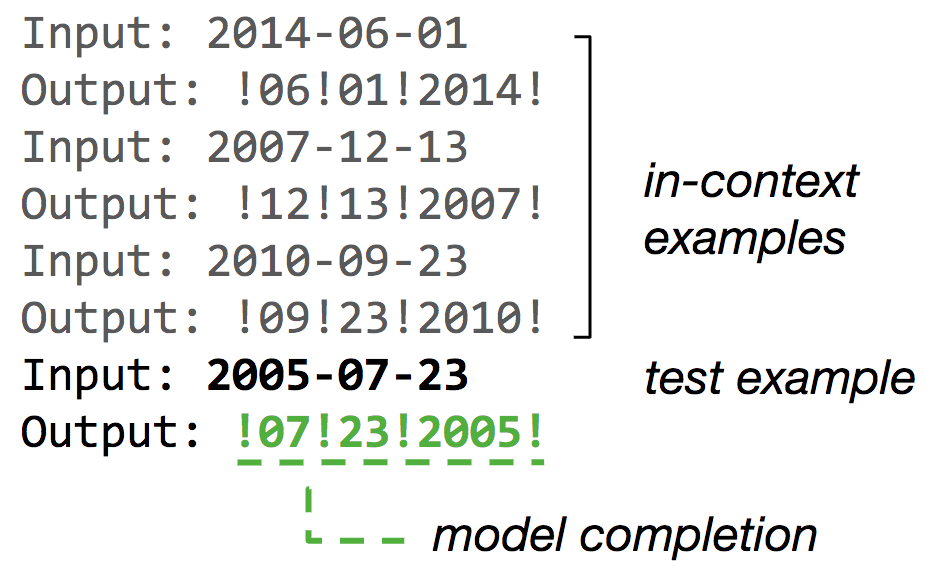
Interestingly, while both arrive at in-context learning differently, both share a similar basic interface of a demonstration video that conditions the model on the policy it needs to learn to perform.
Generalist’s GEN-1.5 learns short skills from a few seconds of sensorimotor data: GEN-1.5 is trained as a large multimodal model that consumes video, language, sensor, and proprioceptive (force/grasp sensing) inputs and produces action trajectories at 100 Hz. Unlike Skild, in-context learning was observed as an emergent behaviour from months of pretraining.
To elicit a desired task, GEN-1.5 is ‘prompted’ by inserting a 3-12-second demonstration video into a 30-second context window. The rest of the rolling context window is used for GEN-1.5 to actually execute on the requested task. Generalist does demonstrate cases where a person demonstrates a task using just their bare hands, but this only works in some cases so far.
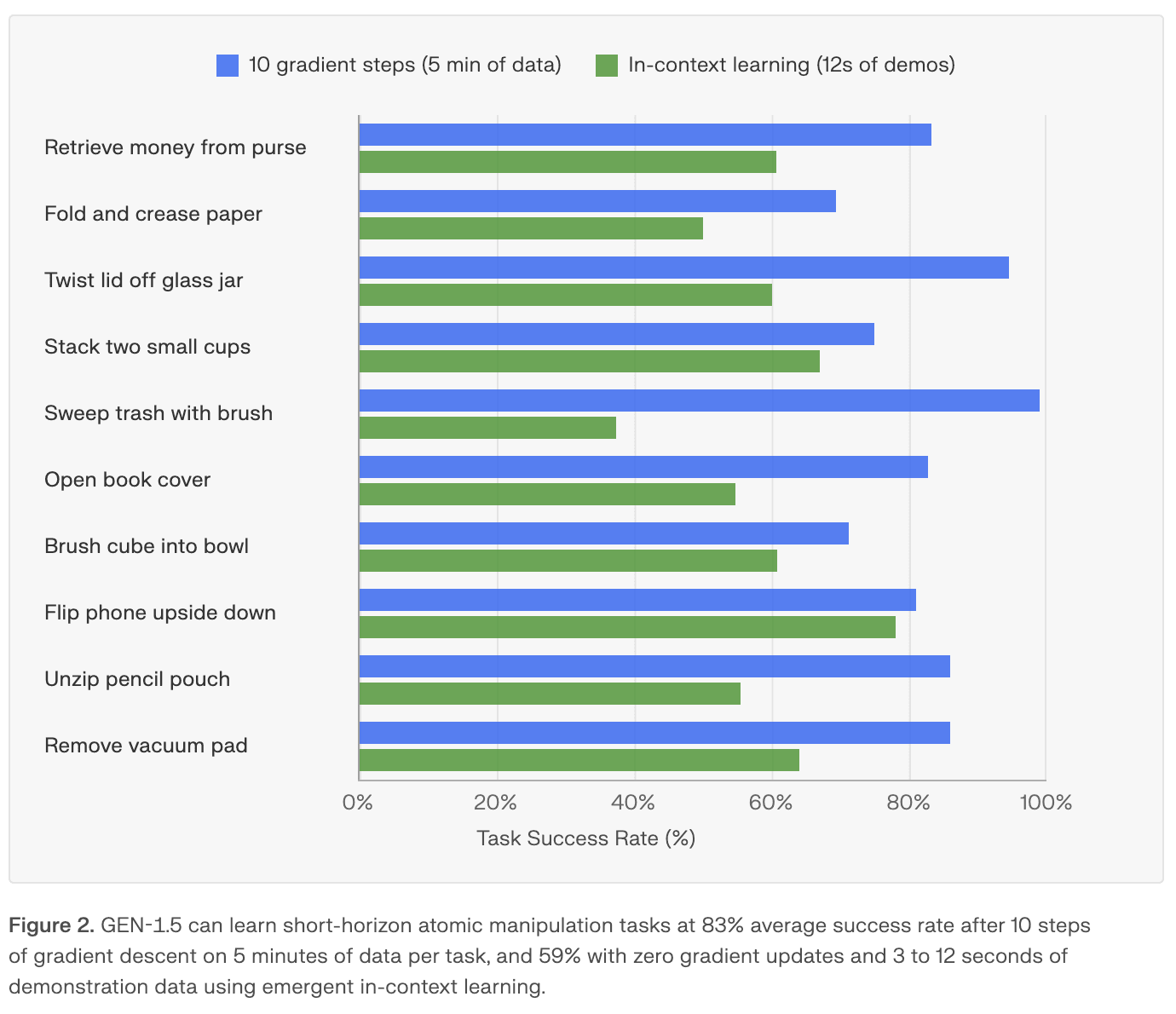
Across ten short manipulation tasks such as opening jars, Generalist reports an averaged 59% first try task success. After ten gradient steps on five minutes of data per task, the same model reaches an average 83% success rate.1 This is no longer in-context learning, but these results suggest that broad capabilities in in-context learning can make it much easier to take a semi-competent attempt at a task with one try to something reliable enough for deployment just given a few gradient updates.
Skild’s S1 can learn long tasks from video alone: S1 takes a single visual demonstration of a desired task from two wrist cameras, translating this into actions needed for a given environment and scene. S1 is able to carry out long-horizon tasks from potting plants to cooking pancakes.
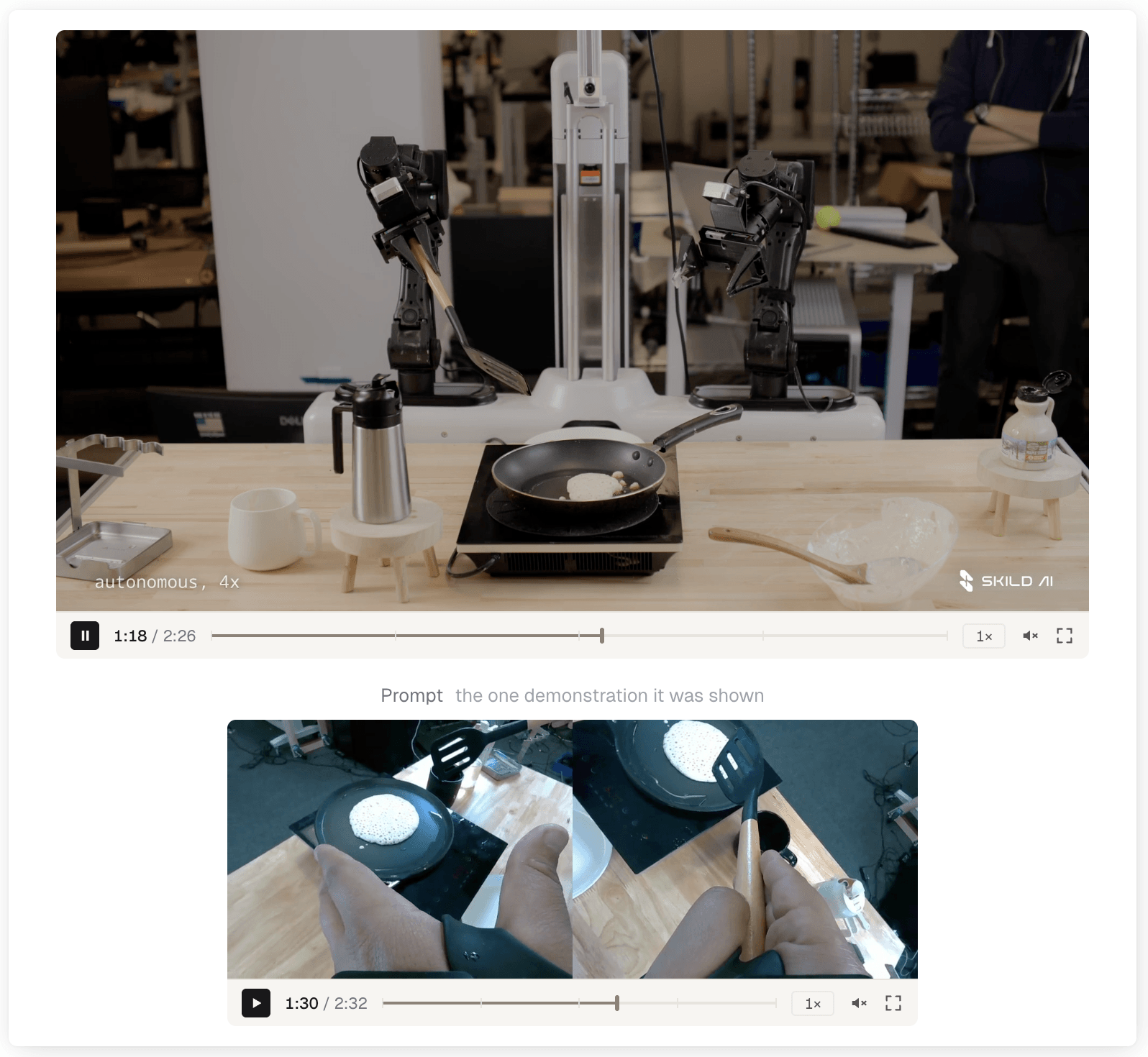
Unlike Generalist, Skild built S1 with the goal of achieving in-context learning, training off of a combination of 100,000 hours of robot teleoperation, UMI demonstrations, egocentric video, and simulation data. During pretraining, tasks are specified through demonstrations rather than language.
Because the same scene may support many possible behaviors, the policy has to inspect the demonstration to know what it should do. Skild describes this as an outer loop in which large-scale pretraining teaches the model how to learn, followed by an inner loop in which the video prompt specifies the task without changing any weights.
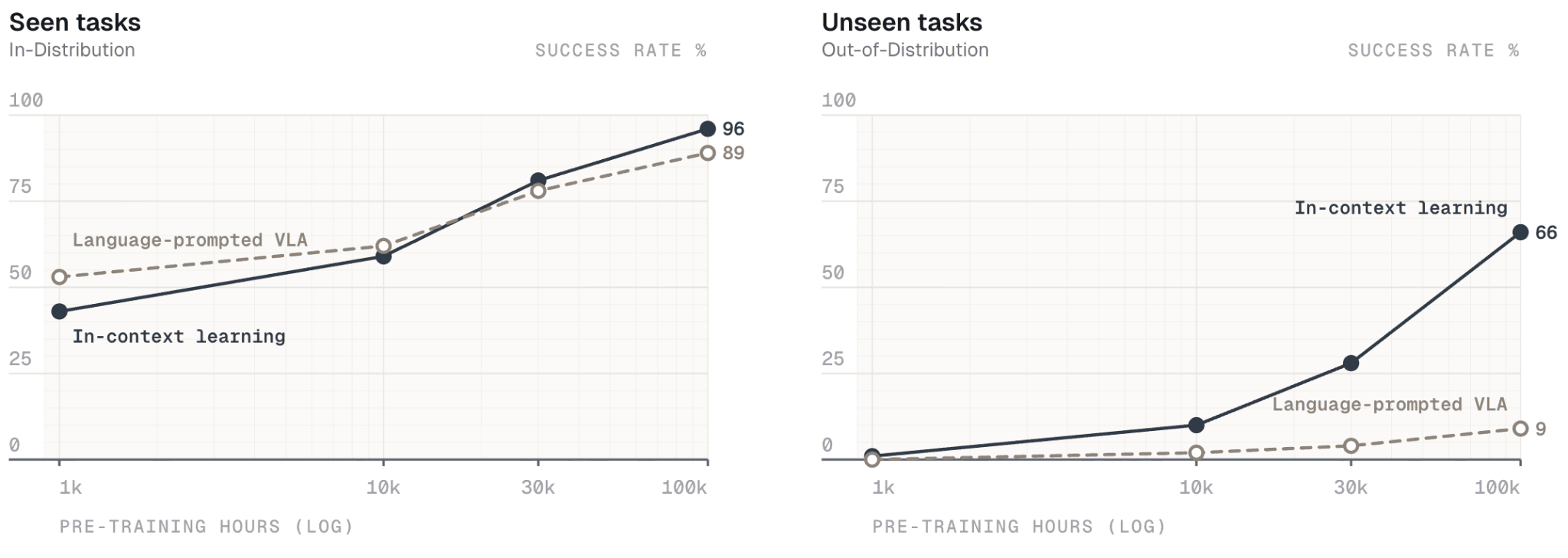
Most exciting is Skild’s scaling study, where they used video-prompted and language-prompted policies trained on datasets ranging from 1,000 hours to 100,000 hours. They found that on in-distribution tasks, language-prompted VLAs performed similarly to in-context learning and both saturated out at around 100,000 hours. But in-context policy noticeably pulled ahead on out-of-distribution tasks, where video-prompted policies reached 66% averaged per-step success compared to just 9% for the language-prompted policy.2
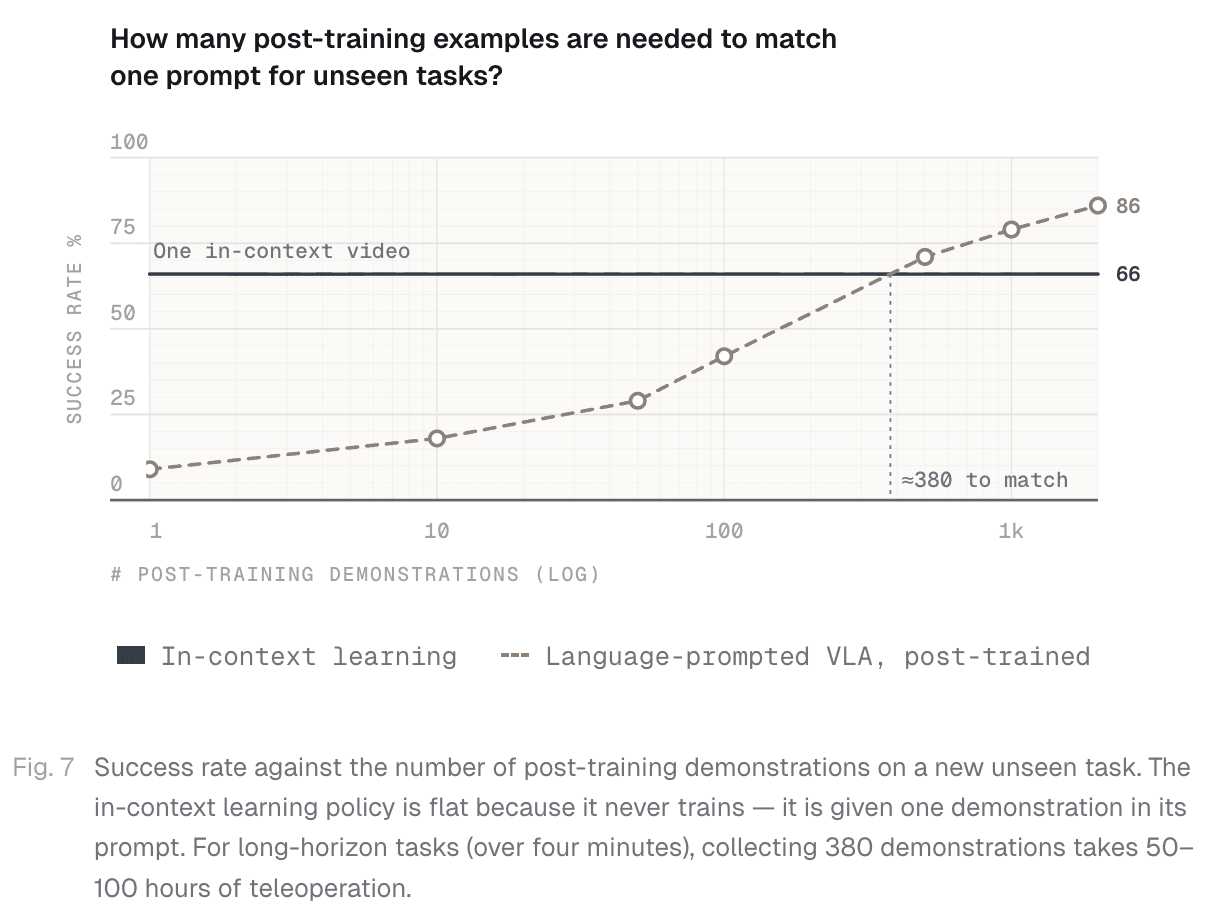
By looking at where these scaling curves crossed, they estimated that one demonstration of in-context video would be equivalent to ~380 examples needed for post-training, which would be around 50 to 100 hours of teleoperation.
Of course, there are still large caveats. Both models are still proprietary, and we haven’t seen any evaluations on non-internal benchmarks emerge either from the companies themselves or from independent evaluators. It’s also difficult to tell just how out-of-distribution a task that is reported as unseen really is without access to the training corpus. In general, we should expect that the demonstrations we’ve seen are pretty much the upper bound to how capable both models are in the real world without additional adjustment.
Why this matters – deploying robots at scale will probably happen sooner than you think: Even if we have general purpose hardware that could theoretically perform thousands of different tasks and jobs, if we required a specialized deployment team to come in and take weeks to collect data for new tasks to then deploy them, the cost of one general purpose machine is functionally many repetitive initialization costs.
But physical prompting can make it a lot easier to deploy robots in the real world. Instead of long deployment processes, a person who already has the tacit knowledge of how to do a task can simply demonstrate to the robot what to do. This could be a technician demonstrating how to assemble a new version of a product, or a household user showing exactly how they want a certain task performed. Breaking these down into accessible task chunks can also open up the pathway for approaches like LLM controllers or policy-as-code that companies experimenting out of the box LLMs can use. The Generalist team summarizes this pretty well:
In practice, this opens up “physical prompt engineering”: rather than collecting a demonstration of a full compound task, one can assemble it from a small library of short, reusable physical prompts. As models improve, composing skills in context may become a practical way to program longer-horizon behaviors; the physical analogue of chaining instructions in a language prompt.
The numbers are not yet good enough to make this one-shot physical prompting work, but continued improvements would be a monumental ‘ChatGPT moment’ for robotics. Accessible deployments at mass scale are arriving sooner than we think.
Sovereignty
The UK government backed the restart of one of the world’s largest tungsten mines and is negotiating rights to half its output. It might offer a preview of a playbook other countries will increasingly consider to resolve dependencies on critical minerals.
Tungsten sovereignty is on the table in the UK
Source: National Wealth Fund backs Tungsten West to unlock critical UK tungsten supply
What are they doing?
The UK’s National Wealth Fund, one of the UK government’s investment vehicles, is investing £36 million (~$49.1 million) for an equity stake in Tungsten West
Up to £35 million (~$47.8 million) will be available as a loan to help cover costs of restarting production
The UK government is negotiating procurement rights for up to half of the mine’s production
The Hemerdon mine is expected to ramp up to full production in Q1 of 2027
John Healey, Chancellor of the Exchequer is pretty clear on what this entails:
We are living in a more dangerous world, which is why backing British industry is more important than ever before… This investment will supply vital minerals to British defence, energy and aerospace businesses - and keep good, well-paid jobs in the UK.
Just how much would this be?
- At steady state, Hemerdon is expected to produce around 2,633 tonnes of contained tungsten annually. Against current production figures, that would amount to roughly 3% of world mine output and skyrocket the UK to third among individual producing countries, behind China and Vietnam but ahead of Kazakhstan.3
- It wouldn’t make a huge dent in the leader – China would still be around four-fifths of the global share of tungsten mined, at around 67,000 tonnes per year.
- Hemerdon could potentially be expanded to around 3,965 tonnes of production. That would be 4.7% of the current global mine production, land the UK in second, and would be around a fifth of all tungsten not mined in China.
- The UK still wouldn’t be able to refine this, and by the government’s own assessment, refinement of exported tungsten concentrate would likely take place in Austria or the United States (in Pennsylvania).
On a headline basis, just the 50% being negotiated for UK government procurement would be comparable in scale to the UK's entire reported tungsten import total: Right now, the UK government is spending billions on ships and weapons that all require tungsten – the Ajax armor-piercing ammo are tungsten projectiles, Type 26 frigate ammunition use tungsten, etc.
Spending billions on these platforms means nothing if you can’t replenish the ammunition they use. By UK import data, China represents 49% of all tungsten imports by mass. It’s fair to say that Britain’s current defense industry depends on a tungsten industry dominated by China. Going off of reported import numbers, the UK imported 1,254 gross tonnes of tungsten in 2025, spanning tungsten concentrates and oxides to powders and scrap. Just the 50% the government is negotiating allocation for could replace all of the UK’s raw tungsten imports by mass.4
For less than one-tenth(!) of the cost of one Type 26 frigate, Hemerdon would be a major step towards the UK protecting their own production of tungsten. The UK still needs its own refining supply chain that can take the mined tungsten and refine it into the end products that are actually imported, either in an allied country or through new domestic refineries, but it’s one of many major steps needed towards its overall defense and mineral sovereignty.
Short Vignettes
You think datacenter populism is bad? Get ready for factory populism.
Source: Factories Are Becoming More Like Data Centers – Robinson Meyer for Heatmap News.
Here’s the TL;DR:
Many of the issues that concern residents about data centers — their power use, water use, and lack of jobs — are not unique to these vast computing facilities. Data centers more closely resemble modern factories and other industrial facilities than they do the vast, job-intensive projects of last century.
The challenge is that in the next few years, more forms of economic development will come to resemble AI data centers than factories or refineries. The country’s steel plants and shipyards used to employ tens of thousands of people. But SpaceX’s rocket factory near Brownsville, Texas, now employs closer to 4,000 people. Taiwanese chipmaker TSMC’s plant in Arizona — probably the country’s most advanced manufacturing facility — employs only 3,000. That number might eventually double, but it still pales in comparison to the heavy industrial sites of old.
Often a town or county will only have a few high-quality sites for economic development, Dunne, the Center for Rural Innovation director, said. Once a facility uses that land, then the community’s economic fate is tied up with that industry.
“I think we’ve all seen the story where over-dependence on a single industry — not to mention a single company — does not go well,” Dunne said.
Overall thoughts – get ready for factory populism. The backlash against data centers may be the canary in the coal mine for what the politics of reindustrialization will look like. As Robinson Meyer at Heatmap argues, the factories coming back from onshoring are similar to datacenters – largely automated, capital-intensive and infrastructure-hungry megaprojects. In the exact same way as datacenters, new fabs, battery plants, and industrial lines can create vast supplier networks and generate invisible tax revenue. But these benefits are similarly invisible, while the costs of noise, grid strain, water consumption, and dependence remain sharp and concentrated.
America is in two weird binds on reindustrialization. On one hand, 80% of Americans believe that we would be better off if more Americans worked in manufacturing, but only a quarter believe they would actually be better off working in manufacturing. And to be competitive on the global stage, factories will need more automation. But the more automation they have, the less likely they are to create the jobs that make industrial development politically attractive in the first place.
American deep tech and industrial companies should be drawing every lesson learned as we turn back towards reindustrialization as a country. If reindustrialization is going to retain local support, the companies themselves will need to offer tangible and visible benefits, operate transparently, and think about ways that they can preempt the biggest risks from populism. Otherwise, America’s coming manufacturing renaissance may run into the same populist opposition now confronting data centers. These kinds of preemption may include being radically transparent about permitting and resource draw, paying for infrastructure upgrades needed, and negotiating community benefits before it becomes a fight.
Japan’s new capital?
Source: Cities Compete in Dizzying ‘Gold Rush’ to Be Japan’s Backup Capital – Javier C. Hernández and Hisako Ueno for the New York Times
Here’s the TL;DR:
Japan’s legislature recently passed a bill to create a secondary capital that would serve as an alternate center for the government’s operations, ensuring continuity in the case of a natural disaster or other emergency.
Designating another capital could also help decentralize Japan’s population and drive economic growth outside the capital. Many people have left rural areas in recent years for jobs and schooling in Tokyo. While the countryside is hollowing out, the population of the Tokyo metropolitan area has grown, rising slightly to 37 million last year.
Overall thoughts – doomed effort? I think it’s extremely interesting and reasonable that Japan is trying to a) derisk a disaster happening to Tokyo and b) that they are trying to promote a second city. The US, for example, has an extremely thorough continuity of government plan that spans at least three major facilities across the US (that we know of!), splitting up core teams to ensure overall survival in disasters like nuclear wars. Japan is also unique among the G7 in just how centralized it is; nearly a third of Japan lives in the Tokyo metro area (the UK has a similar problem, but Greater London is still only 13% of the UK’s total population).
It’s unclear if, like the article says, this will be truly effective at decentralizing Tokyo. It seems unlikely that this will make a dent in Tokyo’s agglomerating force as people around the country migrate there to seek work. We have some limited knowledge of similar efforts – the US has tried to move a large share of federal employees away from DC, but it’s unclear if this has had major positive effects for the regions that they move new jobs to. More cities that offer additional jobs adjacent to the government doesn’t seem like it can counter the vast pull Tokyo has – Japan already has the lowest share of public sector employees (~4.9%) compared to any OECD country (averaging at ~18.4%). And most public sector employees (~82.6%) work for local governments. Of roughly 593,000 national public employees, around 269,000 are part of Japan’s Ministry of Defense personnel; there are only around 324,000 national civil servants!
Next week
Next week, I’m planning to write about the OpenAI & Hugging Face Retrospective. I’d definitely recommend the following sources:
Brief independent investigation of agents’ behavior, reasoning and collaboration in the OpenAI / Hugging Face hacking incident by METR and Redwood Research
The Rise and Fall of Agent Civilizations by Dwarkesh Patel
The Hugging Face attack surprised me by Ajeya Cotra
I’m also planning on writing about the US-Canada trade war. Here’s some sources I’d recommend:
From ‘Fortress North America’ to All-Out Trade War: How the U.S.-Canada Talks Collapsed by Matina Stevis-Gridneff and Ana Swanson for the New York Times
The Real Risk of a Trade War With Canada by Chad Bown for Foreign Affairs
Takes I enjoyed reading
AI
Bill Gates’ warnings about AI
https://www.gatesnotes.com/a-turbulent-ai-era-and-critical-choices-to-make
What’s left for mathematicians?
@boazbaraktcs on X
AI automation will be slow, then everything everywhere all at once
@nikolaj2030 on X
@andy_l_jones on X
How should people write with AI?
@reidhoffman on X
50/50 on RSI by 2030
@peterwildeford on X
Robotics
Just what even is a VLA?
@JitendraMalikCV on X
VLAs and WAMs? Why not both?
@sunfanyun on X
Three bets on robotics
@kshenster on X
America
The Unwelcoming States of America
https://www.economist.com/leaders/2026/08/27/the-unwelcoming-states-of-america
The Right after Trump
https://www.foreignaffairs.com/united-states/new-rights-grand-strategy-after-trump
China
How did China stumble into weaponizing rare earths?
https://www.foreignaffairs.com/china/how-china-found-most-potent-weapon-xiong-weiss
China will pull up the manufacturing ladder through robotics
@jukan05 on X
China’s factories are going overseas
https://www.economist.com/interactive/business/2026/08/19/chinese-firms-are-wrapping-their-supply-chains-around-the-globe
Of course China is overtaking America!
@GuthmannR on X
See also: Matthew Yglesias’ One Billion Americans: The Case for Thinking Bigger
Chinese education in the age of AI
@ZilanQian on X
Europe
Unplugging American software
https://www.economist.com/business/2026/08/16/america-inc-has-a-tight-grip-on-allied-governments
The MICs are coming to Germany
https://www.ft.com/content/2fe2913f-24b7-4074-9278-3253b5b8a61e
Can Europe defend itself?
@Olivier1Schmitt on X
Bonus
How Thailand Resisted Colonization
https://worksinprogress.co/issue/how-thailand-resisted-colonization/
Meta settles over social media addiction claims
https://www.nytimes.com/2026/08/26/technology/meta-settlement-social-media-addiction-lawsuit.html
Footnotes
Generalist reports a standard deviation of 10% for the one-shot result and 9% for the fine-tuned result. ↩
Keep in mind that this 66% benchmark is on per-step success. When a step fails, Skild manually intervenes to recover from failures to grade the full task. ↩
Assuming no other country scales/changes in production by 2025 numbers ↩
Of course, this 1,254-tonne number is the total of many different heterogeneous products including tungsten concentrates, oxides, powders, and scrap. The contained tungsten being produced from Hemerdon wouldn’t be able to immediately replace all of the different products coming in. ↩